My father called on a Tuesday afternoon, as if ten years of silence could be erased by one unexpected phone call.
I was unloading groceries when my mother’s name lit up my screen. At first, I almost ignored it because she was supposed to be in class. She was finishing her nursing program, and during class hours, she never called unless something serious had happened.
Then her text appeared.
“He called. Your father. Can you come over?”
My stomach tightened before I even reached the house.
When I walked into the kitchen, Mom was sitting at the table with her phone placed in front of her like it might explode. A few of my younger siblings hovered nearby, pretending not to listen. Her eyes were red, but her voice was steady.
“He wants to come home,” she said.
For a moment, I actually laughed. Not because it was funny, but because the idea was absurd.
“Home?” I asked. “After ten years?”
She folded her hands tightly. “He says he made mistakes. He says the woman from church left him. He says he misses his family.”
That was my father, Henry. Always using soft words to cover selfish choices.
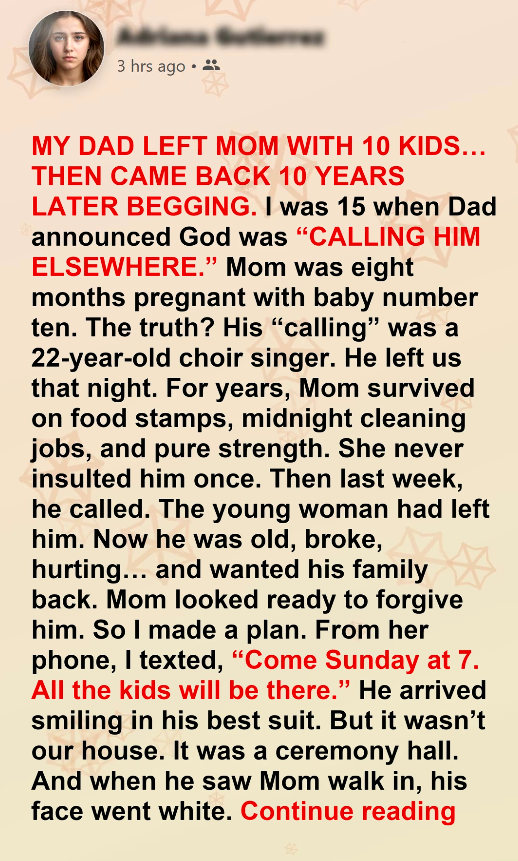
He had walked out when my mother was eight months pregnant with her tenth child. Ten children. No savings. No plan. No apology. Just one suitcase, a Bible tucked under his arm, and a speech about how God was “calling him elsewhere.”
The “elsewhere” turned out to be a twenty-two-year-old woman from the church choir.
Back then, I was fifteen. Old enough to understand betrayal, but young enough to still hope he might change his mind. I remember sitting in the church basement with my siblings while Dad explained his decision like he was delivering a sermon.
“Sometimes,” he said, “a man has to follow the path placed before him.”
My little brother Liam asked, “Are you leaving us?”
Dad smiled sadly, as if he were the one being hurt.
“I’ll always love you.”
Then he left anyway.
Love, I learned that night, means very little when it comes without responsibility.
The years after that were brutal.
Mom worked nights cleaning offices. She came home smelling of bleach, slept three hours, packed lunches, helped with homework, and somehow kept all ten of us moving forward. There were months when the electricity almost got shut off. Weeks when dinner was beans, rice, and whatever coupons allowed.
Dad sent the occasional religious quote by text.
Never money.
Rarely calls.
Never himself.
When we got angry, Mom stopped us.
“Don’t let bitterness make you smaller,” she would say.
I admired her for that, but I was not as forgiving.
So when she told me he wanted to return, something cold and sharp woke up inside me.
“If he wants to see the family,” I said, picking up her phone, “let him see what this family became without him.”
I texted him from Mom’s phone:
“Come Sunday at 7. Family reunion dinner. Wear something nice.”
His reply came almost instantly.
“Thank you for this second chance. I can’t wait to be a family again.”
But there would be no dinner.
That Sunday was my mother’s nursing school graduation ceremony. Even more importantly, she was receiving the Student of the Decade award — an honor she didn’t even know about yet.
For ten years, she had built a future out of exhaustion. She started with one community college class because she refused to scrub office floors forever. Then another class. Then full-time nursing school. She studied at the kitchen table while toddlers slept beside laundry baskets and teenagers whispered multiplication tables around her.
She had become the backbone of a family my father abandoned.
And he was finally going to see it.
On Sunday evening, Mom wore a navy dress and kept asking if she looked overdressed.
“You look like exactly who you are,” I told her. “A woman who survived.”
I met Dad in the parking lot before the ceremony.
He looked older than I remembered. Thinner. Gray at the temples. His suit hung loosely from his shoulders.
“Where is everyone?” he asked, smiling nervously. “I thought this was dinner.”
“It is a family event,” I said. “Come inside.”
When he saw the banner reading Nursing College Graduation and Honors Ceremony, his face changed.
“Your mother is graduating?”
“Yes,” I replied. “Tonight.”
We walked inside together. My siblings were seated near the front. Their expressions hardened when they saw him. My youngest sister Hannah, the baby he had left before she was born, stared at him like he was a stranger from an old photograph.
Because that was exactly what he was.
The ceremony began with speeches and awards. Then Mom’s face appeared on the screen in a slideshow. There she was, years younger, mopping floors in an office hallway with a textbook balanced on a cleaning cart. Another photo showed her studying at our kitchen table while three children slept nearby.
Behind me, Dad inhaled sharply.
The dean stepped to the microphone.
“This year’s Student of the Decade began her journey as a single mother of ten,” she announced. “She worked nights, raised her family, maintained one of our highest GPAs, and never stopped showing up.”
When she said my mother’s name, our whole row stood and cheered.
Mom covered her mouth, shocked, then walked onto the stage with trembling hands.
I had never been prouder of anyone in my life.
Then the dean surprised me.
“Her eldest daughter would like to say a few words.”
My heart pounded as I walked to the microphone. Mom whispered, “Please be gentle.”
I looked at her, then at my father in the audience.
“You were gentle for ten years,” I said softly. “Let me be honest.”
I turned to the room.
“My mother raised ten children alone after the man who called us his blessings walked away. She worked nights, studied before sunrise, and still taught us not to hate him. For years, I thought our family was broken because he left.”
I paused.
“But tonight, I understand the truth. He was never the foundation. She was.”
The room went silent for one breath.
Then applause erupted.
After the ceremony, Dad found Mom outside under the lights.
“I’m proud of you,” he said quietly. “I want to come home.”
Mom looked at him for a long moment.
“I forgave you years ago, Henry,” she said. “But forgiveness does not mean you get to move back in.”
His face fell.
“What about the children?”
“They needed a father ten years ago,” she replied. “You chose not to be one.”
He had no answer.
He left again that night, but this time, nobody chased him.
Inside, someone called for a family photo. We crowded around Mom, laughing and crying as she held her award.
For years, I thought I was the daughter of the man who walked away.
That night, I realized I was the daughter of the woman who stayed.
And that was more than enough.