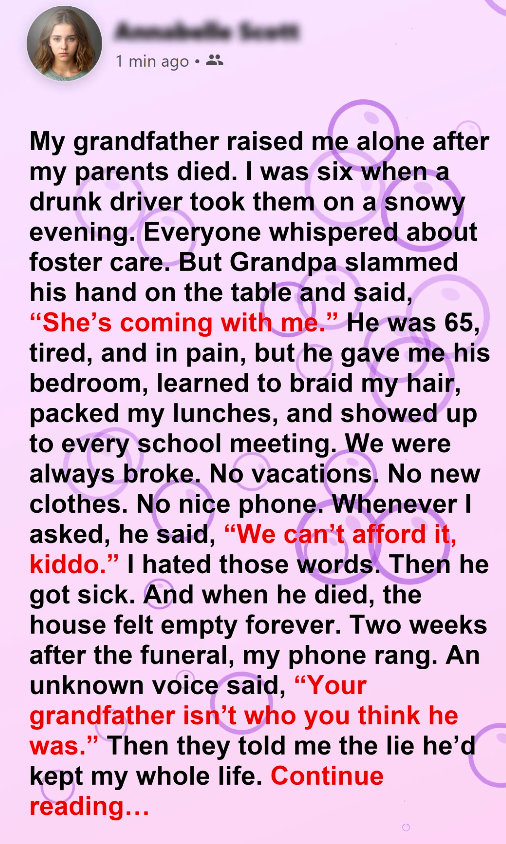
I was six years old when my parents died.
That sentence still feels too heavy to say, even now, years later. One rainy night, they left home to attend a friend’s anniversary dinner and never returned. A drunk driver crossed the center line, and just like that, my entire world was reduced to police lights, black clothes, and adults whispering about what would happen to me.
Some relatives said they wished they could help, but their homes were too small. Others said they were too old, too busy, too financially stretched. Everyone sounded sorry, but no one sounded willing.
Except my grandfather.
He was sixty-five, already retired, and living alone in the small house where my mother had grown up. He walked with a slight limp, kept pain patches in the bathroom cabinet, and had never raised a child by himself. But when the family started discussing foster homes, he slammed his hand on the table.
“She comes with me,” he said. “That is the end of it.”
And so I did.
Grandpa became my whole world. He learned how to pack school lunches, how to braid hair from online videos, and how to sit through parent-teacher meetings on tiny classroom chairs without complaining. He burned pancakes, forgot which cartoon characters I liked, and once sent me to school with two different shoes. But he never made me feel like a burden.
Every birthday, he baked the same crooked chocolate cake. Every winter, he wrapped my scarf twice because he said children never knew when they were cold. Every night, he checked the locks, turned off the kitchen light, and said, “You are safe here, little bird.”
I believed him.
As I grew older, I asked more questions about my parents. Grandpa answered some, but not all. He kept a wooden box in his bedroom closet, and whenever I noticed it, he changed the subject. Once, when I was sixteen, I asked if it held my parents’ things.
His face tightened.
“One day,” he said. “Not yet.”
I thought he meant when I was older.
I never imagined he meant after he was gone.
Grandpa died two weeks after my eighteenth birthday. He had been tired for months, but he hid it well. The morning I found him, he looked peaceful, one hand resting on the blanket, the other near the photograph of my parents he kept beside his bed.
At his funeral, people praised him for being generous and loyal. Relatives cried loudly, even some who had barely visited in years. I stood beside his coffin feeling like a child again, terrified of going home to a house without his voice in it.
Two weeks later, I finally opened the wooden box.
Inside were newspaper clippings, old letters, photographs, and a sealed envelope with my name on it.
My hands shook as I opened it.
The letter was from Grandpa.
He wrote that he had loved me from the moment I was born, but there was something he had never found the courage to tell me. My parents’ accident had not been as simple as everyone believed. The drunk driver who killed them had not been a stranger.
He was my father’s older brother.
My uncle.
The same uncle who attended every Christmas dinner. The same man who called my grandfather “dramatic” for refusing to forgive. The same relative who occasionally sent me birthday cards signed, “Family is everything.”
I stopped reading and sat on the floor, unable to breathe properly.
The newspaper clippings confirmed it. My uncle had been driving after drinking at a private party. My parents had left that same party early after arguing with him about his behavior. Minutes later, he followed them onto the road, lost control, and caused the crash.
He survived.
They did not.
Grandpa’s letter explained why I never knew. The family begged him to stay quiet for my sake. They said I was too young, that hatred would poison me, that losing my parents was already enough. My uncle served time, but the details were kept away from me. When he returned, some relatives decided it was better to “move forward.”
Grandpa never moved forward.
He simply moved around the truth, building a safe childhood for me while carrying the anger alone.
At the bottom of the letter, he wrote:
“I did not tell you because I wanted your life to be bigger than the night that stole your parents. But you are grown now. You deserve the truth. Do not let it make you cruel. Let it make you free.”
For days, I felt betrayed by everyone.
Then my uncle came to the house.
He said he heard I had been “going through old things.” He looked nervous, smaller than I remembered. When I asked him directly, he lowered his head.
“I made a terrible mistake,” he whispered.
“No,” I said. “A mistake is forgetting a birthday. You took my parents and let me sit beside you at family dinners without knowing.”
He cried, but I felt nothing.
Maybe forgiveness will come one day. Maybe it will not. I am no longer forcing myself to decide quickly.
What I know is this: my grandfather did not lie because he was ashamed of me. He stayed silent because he wanted my childhood to contain more than grief.
He gave me a home. He gave me safety. And when he could no longer protect me from the truth, he left it in my hands.
Grandpa raised me alone.
But after his funeral, I learned he had also carried my heaviest pain so I would not have to.