For three years, Katie believed her husband was dead.
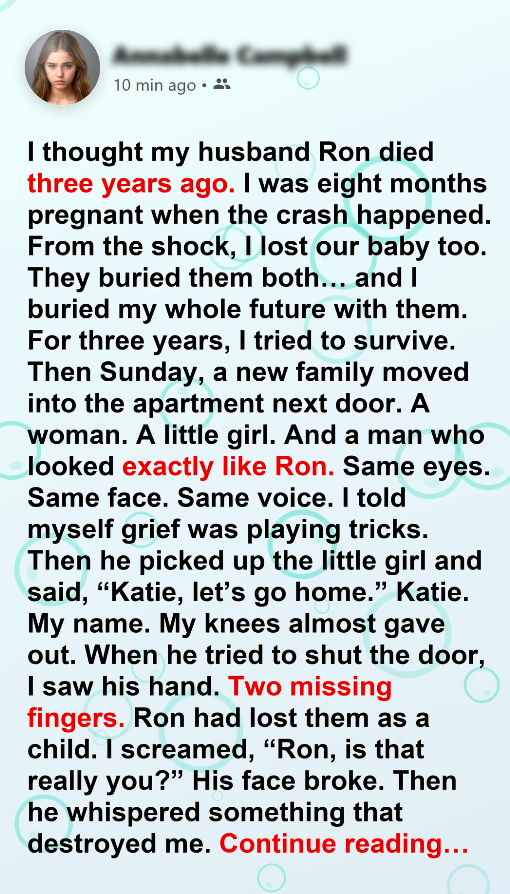
She had buried him in a closed casket after a car crash no one let her question. She had stood beside his grave while eight months pregnant, one hand on her stomach, trying to understand how a normal morning had become the end of her entire life.
Ron had been driving alone when his car supposedly went off the road. The police called it a tragic accident. His aunt handled most of the arrangements because Katie was too shocked to think clearly. The casket stayed closed. The funeral happened quickly. Everyone told Katie it was better that way.
But grief did not stop there.
The stress took her baby the next day.
In less than a week, Katie lost her husband, her daughter, and every version of the future she had imagined. The small nursery remained untouched for months. The crib stayed against the wall. Tiny clothes hung in the closet with tags still attached. She could not bring herself to pack them away, but she could not bear to look at them either.
Eventually, survival became a routine.
She moved to another city, found a quiet apartment, and took a job that kept her busy enough to avoid remembering. She stopped celebrating birthdays. She stopped talking about Ron. When people asked if she had ever been married, she simply said, “A long time ago.”
Then, one Sunday morning, a moving truck parked outside her building.
Katie watched from her window as a young family carried boxes into the apartment next door. A woman with dark hair held the hand of a little girl. A man lifted a lamp from the truck, laughing at something the child said.
At first, Katie only felt a dull ache. That could have been her life. That could have been Ron carrying furniture while their daughter ran ahead, excited about a new home.
Then the man turned toward the building.
Katie stopped breathing.
He had Ron’s face.
Not a resemblance. Not the vague similarity that grief sometimes invents. The same eyes. The same mouth. The same scar near his chin from a childhood fall.
Katie backed away from the window, shaking. She told herself it was impossible. Ron was dead. She had buried him. She had mourned him. She had nearly broken herself trying to survive his absence.
But later that evening, she heard his voice through the wall.
Her knees weakened.
The next morning, she waited in the hallway. When the apartment door opened, the man stepped out carrying a trash bag. He froze the moment he saw her.
“Katie,” he whispered.
That one word destroyed every excuse her mind had built.
She stared at him, unable to move. “You’re supposed to be dead.”
Ron looked older, thinner, and terrified. For a moment, he glanced back toward his apartment, as if afraid the woman inside might hear.
“I can explain,” he said.
“No,” Katie replied. “You can confess.”
The truth came out in pieces.
Ron had been drowning in debt. Not the kind of debt that came from bills and bad luck, but from risky decisions, lies, and people he had promised money he could not repay. Instead of telling Katie, instead of facing consequences, he had chosen disappearance.
His aunt helped him arrange the fake death. There had been no body in the casket. The paperwork had been pushed through with lies and favors. Ron left town with a new name and built another life while Katie buried an empty coffin and lost their child alone.
The woman next door, Carla, had no idea.
Ron had told her Katie abandoned him years ago. He had painted himself as the wounded man who deserved a second chance. Their little girl even had a name painfully close to the one Katie had chosen for her own baby.
When Carla finally learned the truth, she went pale.
“I didn’t know,” she told Katie, tears in her eyes. “I swear I didn’t know.”
Katie believed her. Carla looked just as trapped inside Ron’s lie as she had once been.
That afternoon, Katie stopped crying and started making calls.
She requested records. She contacted the authorities. She gave names, dates, addresses, and every detail she could remember. The death certificate was investigated. The funeral paperwork was reviewed. Ron’s aunt was questioned.
By the end of the week, the story Ron had buried began rising to the surface.
There was fraud. Forgery. False identification. A life built on documents that should never have existed.
Ron begged Katie not to ruin him.
She looked at the man she had once loved and felt nothing but exhaustion.
“You already ruined me,” she said. “I just survived it.”
When police finally came, Katie watched from her doorway as Ron was led out of the apartment next door. Carla held her daughter close, crying silently.
Katie did not feel victorious.
No arrest could return the years. No confession could bring back her baby. No apology could erase the image of that closed casket or the empty nursery she had left behind.
But as the hallway grew quiet, Katie understood something important.
For three years, she had believed grief was the truth.
It wasn’t.
The truth had been hidden, manipulated, and buried by people who counted on her pain to keep her silent.
Now, for the first time since the funeral, Katie locked her door, looked around her small apartment, and felt the air change.
Ron had come back from the dead.
But Katie was the one who finally came back to life.