My grandfather’s farm was never just a piece of land to me.
It was the place where I learned how to wake before sunrise, how to fix a fence with cold hands, and how to tell the weather by the weight of the air. It was also the place that saved me when life took everything else.
After my parents died, Grandpa became my whole family. He raised me in that old farmhouse, taught me the names of every field, and showed me that love could be quiet, steady, and practical. He did not say much, but he showed up. Every single day.
Years later, when my wife passed away, I brought my three children back to that same farm. Grandpa was already getting weaker by then. His hands shook. His steps slowed. But his mind stayed sharp, and his heart remained bigger than the house he had built.
For ten years, I cared for him.
I managed the harvest, paid the bills, repaired the roof, changed his bandages, drove him to appointments, and raised my children under his roof. It was exhausting, but I never saw it as a burden. He had carried me once. It was my turn to carry him.
My Aunt Linda, however, saw things differently.
She had left for the city decades earlier and rarely called unless she needed money or wanted to complain. She did not visit when Grandpa became sick. She did not come when he could no longer walk to the barn. She did not sit beside him during his final days.
But the moment he died, she arrived.
A shiny Mercedes rolled up the gravel driveway before the funeral flowers had even wilted. Linda stepped out wearing designer sunglasses and a black coat that looked more expensive than our tractor repairs.
She did not hug me. She did not ask how the children were doing.
She looked at the farmhouse and said, “This place needs serious work.”
For the next three days, she walked through Grandpa’s home as if she were inspecting a property she had already purchased. She pointed at furniture and said what could be thrown away. She opened cabinets. She talked about selling the land, cutting down trees, and turning the farmhouse into a weekend rental.
My children stayed quiet, confused and scared.
Then, on the morning before the will reading, Linda cornered me in the kitchen.
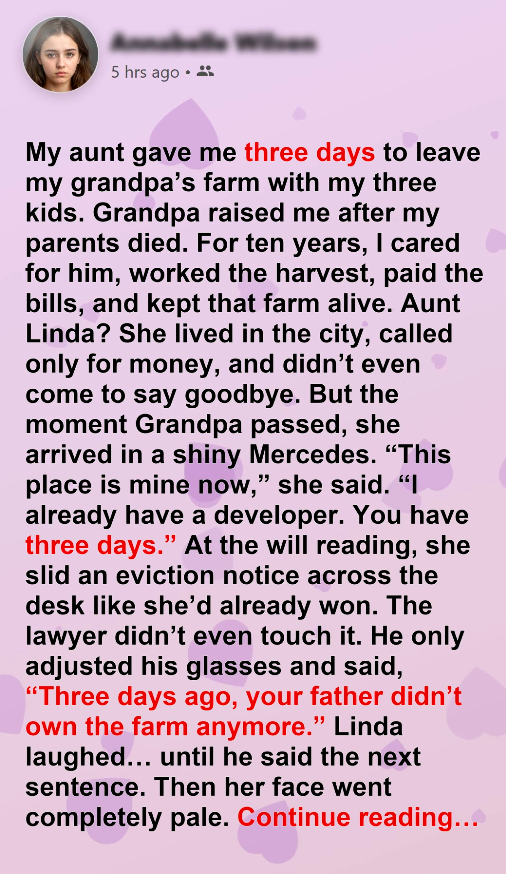
“You have three days,” she said.
I stared at her. “Three days for what?”
“To leave,” she replied, smiling as though she were being generous. “You and the kids have lived here long enough. Dad is gone. The farm belongs to the family now, and I’m not letting you squat in it.”
The word hit me harder than I expected.
Squat.
I had given my adult life to that land. I had held Grandpa’s hand through pain, fear, and final breaths. Yet she stood in his kitchen calling me a stranger.
I wanted to shout. Instead, I looked at my children standing in the hallway and said nothing.
The next afternoon, we all gathered in the lawyer’s office.
Linda sat confidently with her legs crossed, already speaking about market value and buyers. My cousins whispered behind her. I sat in the corner, tired, grieving, and prepared for the worst.
The lawyer opened Grandpa’s will and began reading.
Most of it was simple. Personal items. Small gifts. A few savings accounts.
Then he reached the farm.
Linda leaned forward.
The lawyer adjusted his glasses and read one sentence that changed everything.
“The farm, farmhouse, equipment, and surrounding land are left entirely to my grandson, who stayed when everyone else left.”
The room went silent.
Linda’s face lost its color.
“That can’t be right,” she snapped. “I’m his daughter.”
The lawyer looked at her calmly. “Your father addressed that.”
He pulled out a handwritten letter.
In it, Grandpa explained that family was not measured by blood alone. It was measured by loyalty, sacrifice, and love shown when there was nothing to gain. He wrote that I had kept the farm alive. I had cared for him without asking for reward. I had given my children a home there.
Then came the line that broke Linda’s composure completely.
“Linda wanted my land. My grandson protected my life.”
She stood up so quickly her chair scraped the floor.
“This is manipulation!” she shouted.
But the lawyer remained calm. The will was legal, signed, witnessed, and clear.
Linda left without speaking to me.
That evening, I returned to the farm with my children. The house felt different. Still sad, still quiet, but no longer threatened.
My youngest asked, “Does this mean we can stay?”
I looked out at the fields Grandpa had loved and felt tears finally rise.
“Yes,” I said. “We can stay.”
Because in the end, my aunt inherited the lesson she never wanted.
And I inherited the home my grandfather knew I had already earned.