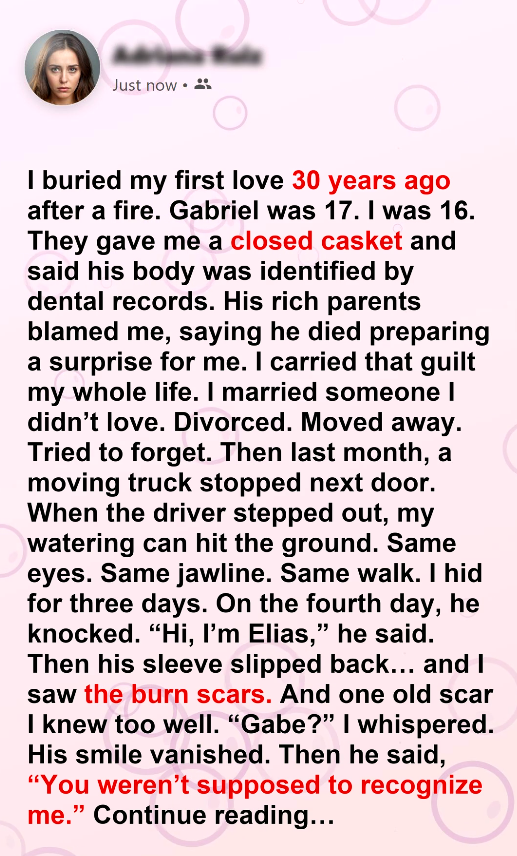
For thirty years, Samantha believed the boy she loved had died in a fire.
Gabriel was her first love, the kind of love people tell teenagers they are too young to understand. She was sixteen, the daughter of a hardworking mechanic. He was seventeen, born into a wealthy family that treated reputation like oxygen. His parents never approved of her. They smiled politely in public, but Samantha always felt the judgment behind their eyes.
Then came the fire.
Gabriel had gone to his family’s lake house one winter evening. The official story was simple: an accident, smoke, a closed casket, and grieving parents who refused to let Samantha say goodbye. She stood at the funeral with shaking hands, listening to people whisper that Gabriel had died because of her.
After that, life moved on, but Samantha did not.
She married later, divorced quietly, cared for her father until his passing, and returned to a small, silent home filled with memories she never admitted were still alive. Every spring, she planted hydrangeas because Gabriel had once said blue flowers looked like “pieces of sky that fell to earth.”
Then, one ordinary morning, a moving truck stopped next door.
Samantha was watering those flowers when she saw him.
The man stepped out slowly, older now, with gray at his temples and a scar near his jaw. But his eyes were the same. His posture was the same. Even the way he paused before looking up felt painfully familiar.
Her watering can slipped from her hand.
For three days, she avoided the window. She told herself grief could play cruel tricks. Maybe every woman who lost someone young eventually saw his face in strangers.
On the fourth morning, someone knocked.
When she opened the door, the man stood there holding a basket of muffins.
“My name is Elias,” he said softly. “I just moved in next door.”
Samantha stared at him. Her voice came out barely above a whisper.
“Why do you look like a man I buried thirty years ago?”
The basket lowered in his hands.
His face changed.
Not surprise. Not confusion.
Recognition.
“Sammie,” he said.
Only Gabriel had ever called her that.
The world seemed to tilt beneath her feet. She grabbed the doorframe, unable to breathe, unable to decide whether to scream, cry, or slam the door in his face.
He asked if he could explain.
Against every instinct, she let him in.
At her kitchen table, the truth came out piece by piece. The fire had not been a simple accident. Gabriel had survived, badly injured and confused, but his parents saw an opportunity. They moved him overseas under another name, controlled his treatment, his documents, his access to the outside world. They told him Samantha had moved on. They told Samantha he was dead.
For years, Gabriel had lived inside a life designed by other people.
His memories had returned slowly. A laugh. A garage. A girl with oil on her hands and blue flowers in her hair. By the time he understood who he was, his father had died, and his mother still held power over nearly everything.
“But why now?” Samantha asked, tears burning her eyes.
Gabriel placed an old photograph on the table.
It showed two teenagers smiling beside a beat-up truck. Their arms were wrapped around each other. Young. Hopeful. Unaware that life was about to separate them.
“I finally found proof,” he said. “And I came back because I’m tired of being erased.”
Samantha looked at the photo, then at the man in front of her. Part of her wanted to mourn all over again. Another part wanted answers, justice, and every stolen year returned.
“You let me grieve you,” she whispered.
“I know,” he said. “And I will spend whatever time I have left making peace with that.”
The next week, Gabriel’s mother arrived in a black car, elegant and cold as ever. She warned Samantha to stay away. She called Gabriel fragile. Confused. Unwell.
But this time, Samantha was not sixteen.
She stood beside Gabriel and said, “No. This time, the truth speaks.”
Some love stories do not end when people bury them.
Some wait quietly beneath the ashes, until someone is brave enough to uncover what really burned.