The night Nika and Angela were born, I made a promise that changed the rest of my life.
I was a young midwife then, still new enough to believe that if I followed every rule, every patient would make it home. Their mother arrived exhausted, frightened, and far too weak for the battle ahead. She was young, alone, and holding on to life with a strength that broke my heart.
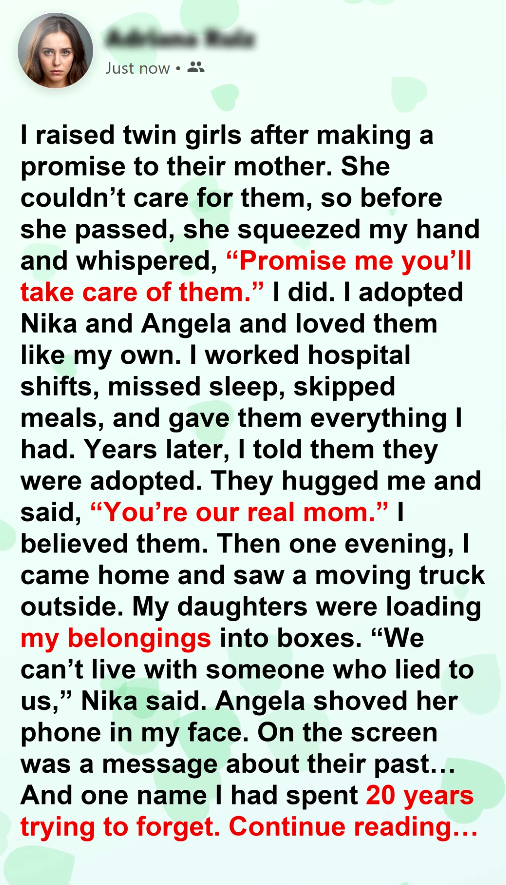
During labor, she grabbed my wrist with surprising force.
“I can’t raise them,” she whispered. “Please. Promise me they won’t be alone.”
I tried to calm her. I told her to save her strength. But she would not let go until I answered.
So I promised.
A few hours later, two tiny girls entered the world. Their mother looked at them once, smiled through tears, and gave them their names.
Nika and Angela.
By morning, she was gone.
The hospital staff spoke in low voices after that. The babies had no relatives present. Their father was unknown to us. Social services would come. The girls would likely be separated or placed wherever space could be found.
I looked at those newborns in their bassinets and heard their mother’s voice again.
Promise me.
I had no husband, no savings, and no experience raising children outside hospital walls. But I had two arms, a small apartment, and a heart that refused to abandon them.
So I adopted them.
The first years were beautiful and brutal. I worked long shifts, came home exhausted, warmed bottles at midnight, learned to braid hair badly, and memorized lullabies through tears of fatigue. I missed parties, promotions, sleep, and any chance at an easy life.
But I never regretted them.
Nika was bold, always asking questions. Angela was gentle, always watching before she spoke. They grew up calling me Mom, and every time they said it, something inside me healed.
I told them they were adopted when they were old enough to understand. I told them their birth mother had loved them. I told them she had asked me to protect them.
What I did not tell them was that their father might still be alive.
That was the part I buried.
Years after their adoption, a man named Stefan appeared at the hospital asking about a woman who had died giving birth. He had been deployed overseas, he said. He had not known she was pregnant when he left, and by the time he returned, everything was already over.
When he learned the twins had been adopted, his face collapsed.
I should have told the girls.
I know that now.
But they were five years old. Happy. Safe. Mine in every legal and emotional way. Stefan was a stranger with grief in his eyes and no proof he could give them stability. He left his contact information, but after a few unanswered calls and one letter, he disappeared from my life.
I told myself I was protecting them.
For fifteen years, that lie sat quietly between us.
Then, shortly after their twentieth birthday, Nika found an old envelope in my documents. Stefan’s name. His letter. His request to know his daughters.
By the time I got home from work, both girls were waiting in the living room.
Angela’s eyes were red. Nika’s hands were shaking.
“Did you know?” Nika asked.
I could have lied again.
I didn’t.
“Yes,” I said softly.
The room changed forever.
They shouted. They cried. Angela asked how many birthdays their father had missed because of me. Nika said I had stolen their choice. I tried to explain fear, timing, and love, but every word sounded small compared to the truth.
Then Nika said the sentence that broke me.
“We can’t live with someone who lied to us our whole lives.”
They packed bags. They asked me to leave the house for a few days, even though it was the home I had built for them. I went to a friend’s apartment with one suitcase and twenty years of motherhood suddenly hanging by a thread.
A week later, Angela called.
Her voice was quiet.
“We met him.”
I sat down before she continued.
Stefan was kind, she said, but broken in ways they had not expected. He had never stopped looking for them, but he had also never been ready to fight. He admitted he had given up too easily. He told them I had done what he could not: stayed.
When the girls came home, they did not run into my arms.
Forgiveness is not that simple.
But Angela placed her hand over mine and whispered, “You should have told us.”
“I know,” I said.
Nika looked away, then added, “But you didn’t abandon us.”
That was the beginning.
Not of forgetting. Not of pretending the lie had not hurt them. But of rebuilding something honest from the ruins of something loving and flawed.
I kept my promise to their mother.
But I learned too late that protecting someone with silence can still wound them.
Love raised my daughters.
Truth had to bring them back.